|
Abba Tor, P.E., F.ASCE, speaks deliberately, and with a hint of nostalgia, about his long career as an engineer. He matter-of-factly mentions former colleagues and architectural icons like Louis Kahn, Eero Saarinen, Charles Correa, and Kevin Roche and former projects like the Yale Mellon Center for British Studies, the TWA Terminal at John F. Kennedy International Airport, and the Permanent Mission of India to the U.N. As Tor’s story unfolds, it becomes evident that he lives for a challenge, which might explain why he gravitated towards architects who consistently pushed the boundaries of their craft and demanded an engineer who could help them accomplish their vision.
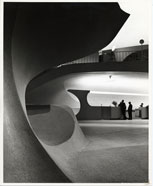 Tor’s first major challenge came in 1957 when he began work on the TWA Terminal as an engineer with the Amman and Whitney team; he was 33 years old. He had never worked with the project’s designer, Eero Saarinen, before, but he knew of his work. Tor’s first major challenge came in 1957 when he began work on the TWA Terminal as an engineer with the Amman and Whitney team; he was 33 years old. He had never worked with the project’s designer, Eero Saarinen, before, but he knew of his work.
“Saarinen was a shape-giver,” Tor recalls. “He was always searching for the right form for the building involved…and sometimes the structural aspects of his work did not easily fall into logical engineering solutions. You had to kind of argue your way into it; so there was always a certain element of tension, but it was the kind of tension that brought out the possibility of creative solutions and compromises.”
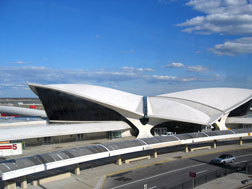 One of the particularly important “compromises” occurred in the project’s early stages. Saarinen’s original design called for the entire roof—all 1.4 acres of it— to be one continuous undulating shape; a design concept often referred to irreverently by some as the “flying brassiere.” One of the particularly important “compromises” occurred in the project’s early stages. Saarinen’s original design called for the entire roof—all 1.4 acres of it— to be one continuous undulating shape; a design concept often referred to irreverently by some as the “flying brassiere.”
“We had to convince him and his people that the roof needed joints and separation because it was not possible to have such a large area of concrete poured without the concrete shrinking, which would lead to cracking later on,” Tor explains. Tor proposed that joints be introduced between the shells. This was done and the joints served as another function as the building’s three-foot-wide skylights.
Read the rest of the article about engineer Abba Tor
Saarinen’s Shadows
On Saturday June 21, as part of the National Building Museum’s ARCHitecture Family Day, shadow puppeteer Daniel Barash will host a hands-on family workshop titled “Saarinen’s Shadows” as part the National Building Museum’s ARCHitecture Family Day. Barash is the director of the Shadow Puppet Workshop based in Silver Spring, Maryland. His one-man theater program has worked with more than 100,000 students and has been presented across the United States and around the world.
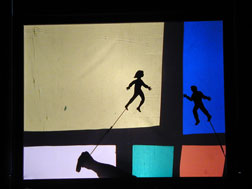 The ARCHitecture Family Day puppet workshop centers around Eero Saarinen’s world-famous St. Louis Arch. The arch, once seen as a window to westward expansion, will serve as a window to the future. Families will work together to create puppet characters and the puppet show scenery based on their view of the future. The workshop culminates in a shadow puppet performance featuring all the participants. Saarinen’s Shadows begins at 10:30 am and ends at 12:00 pm. Participation is on a first-come, first-served basis and we recommend arriving promptly. The ARCHitecture Family Day puppet workshop centers around Eero Saarinen’s world-famous St. Louis Arch. The arch, once seen as a window to westward expansion, will serve as a window to the future. Families will work together to create puppet characters and the puppet show scenery based on their view of the future. The workshop culminates in a shadow puppet performance featuring all the participants. Saarinen’s Shadows begins at 10:30 am and ends at 12:00 pm. Participation is on a first-come, first-served basis and we recommend arriving promptly.
NBM Online: How did you first become involved with shadow puppets? What was their appeal?
Daniel Barash: Interestingly enough, when I was living in New York City after college, I saw shadow puppetry being used as part of a Purim play at my synagogue. I was immediately impressed with its simple yet profound way of conveying a story, and knew that at some point, I wanted to try my hand at it.
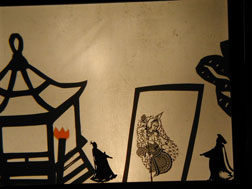 A few years later, after I had received my master's degree, [and was working as a] Theater Arts Specialist in the public schools, I had the opportunity to use it in the classroom. Fifth grade students were exploring folktales, and I developed a shadow puppetry folktale unit to explore the genre's characteristics. Both teachers and students enjoyed the shadow puppetry medium, and the students, regardless of their learning styles, found a way into the curriculum via this unique performance art. A few years later, after I had received my master's degree, [and was working as a] Theater Arts Specialist in the public schools, I had the opportunity to use it in the classroom. Fifth grade students were exploring folktales, and I developed a shadow puppetry folktale unit to explore the genre's characteristics. Both teachers and students enjoyed the shadow puppetry medium, and the students, regardless of their learning styles, found a way into the curriculum via this unique performance art.
Read the rest of the interview with shadow puppeter Daniel Barash |
|
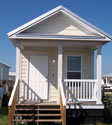
Community in the Aftermath
The Alternative Housing Pilot Program: Building a Framework for Future Disaster Recovery
Thursday, June 19, 6:30 8:00 pm
In partnership with the U.S. Department of Housing and Urban Development, the Museum launches a new, three-year lecture series. The inaugural program explores critical issues and objectives of the AHPP, funded by FEMA. AHPP is a grant competition to develop more readily available and culturally appropriate post-disaster housing for Hurricane Katrina-ravaged areas. Learn more
 Community in the Aftermath is sponsored by the US Department of Housing and Urban Development and the Federal Emergency Management Agency in partnership with the National Building Museum. Community in the Aftermath is sponsored by the US Department of Housing and Urban Development and the Federal Emergency Management Agency in partnership with the National Building Museum.
Shop!
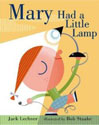
Mary Had a Little Lamp
by Jack Lechner; illustrated by Bob Staake
A new twist on the classic rhyme, updated with “appliance humor!” Mary has a little lamp she takes everywhere, until one day she leaves it at home. Now what will she find instead?
$14.35 Members / $15.95 Non-members
Purchase now in our online shop
Q: Eero Saarinen's father, Eliel, famously won second place in the 1922 design competition for the Chicago Tribune Tower. Ten years earlier, in 1912, he won second place in another famous international design competition. What was it?
Think you know the answer? Find out. | |




