|
On July 17, Michael Maltzan, FAIA will speak at the National Building Museum as part of the Spotlight on Design lecture series. Maltzan is the founder of Michael Maltzan Architecture located in Los Angeles, California. His work endeavors to synthesize the ambiguity of the contemporary world through architecture that is a catalyst for new experiences and change; it has been recognized with dozens of national and international awards including the AIA’s Young Architect’s Award. NBM Online contributor Andrew Caruso, president and chairman of the board for the American Institute of Architecture Students (AIAS) spoke to Maltzan about the role of technology in architecture, his interest in socially-motivated design, and more.
Andrew Caruso: Your design process is founded in exploring ideas three dimensionally. How then does one come to understand the importance of craft and a culture of “making” to your work?
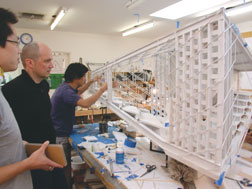
Michael Maltzan: Simultaneity is one of the most compelling issues confronting architectural design and public social space today. As we confront this in design, models create a three-dimensional matrix of ideas held simultaneously in space that you can move around to understand complex interrelationships within the project in same-time. It is for this reason that our ideas are examined and realized in 3D physical and digital models. These processes are parallel ones; however, the more traditional tool of the physical model allows us to look at highly contemporary problems with great fluidity.
|
|
The idea of craft is a complicated issue especially in the U.S. For us, modeling, from design to construction mockups, is part of a continuous visualization process where the form of the building—and eventually the details, materials, and technique of producing the building—are an ongoing line of investigation. In that sense, I would not say modeling is directly related to your question of craft, but it does begin to take on issues of contemporary building culture and how the building will be built.
Caruso: Are generational differences revealed in your office through technology?
Maltzan: All generations approach work from various cultural, social, and even technical lenses. For a time, an unhealthy divide existed between those producing work digitally versus those producing work physically. In our office, physical models may have the greatest currency in terms of telling the real story of what we are trying to accomplish. That line, however, is getting blurrier. We find ourselves producing physical models digitally, just as much as we sit with hot glue, scotch tape, and scissors. It is becoming a blend of techniques more focused on moving the ideas and designs forward, and those generational differences you alluded to are giving way to a common conversation about how to approach architecture.
|
 |
Caruso: You describe your design approach as being a process of discovery and resolution, beginning at the moment of distilled questioning. How much of this process is fundamental, enduring, and consistent, and how much of it is reflective of the unique complexities of each situation?
Maltzan: This is the question that I ask every time we start a project. I am looking for the moment where there begins to be a trajectory, a direction for the design. We try a lot of different things, we make a lot of different things, and we throw out a lot of different things. It is a search for ideas that are strong enough; ideas that will have enough credibility and endurance to survive the long design process. Out of that deep immersion, out of the conviction to make a lot of things and the willingness to throw a lot of them away, inevitably, an idea finally sticks.
To a large extent, beginnings are always extremely fragile and ideas easily defeated. I think design beginnings require a conviction about the end; a belief that following your path will ultimately get you to something strong. It takes a degree of time for any architect to begin to trust their intuition.
Read the rest of Michael Maltzan’s interview.
Register for the Spotlight on Design lecture.
Spotlight on Design is sponsored by Lafarge, the world leader in construction materials, with additional support from the American Institute of Architects.
The Coolest Show in Town!
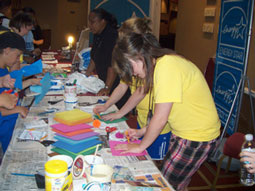
The National Building Museum will be cooling off this summer when it hosts a special exhibition called The Art of Recycling: The Coolest Show in Town. From August 25 until September 2, the Great Hall will be filled with energy-efficient and environmentally-themed artwork created from old refrigerators as part of the U.S. Department of Energy’s ENERGY STAR® “Recycle My Old Fridge Campaign.”
Students, institutions, utility companies, private organizations, and individual artists across the country were invited to submit decorated refrigerators or refrigerator doors through July 15 for inclusion in the exhibition. Up to 51 entries will be accepted for The Art of Recycling, and visitors to the exhibition can vote for their favorite refrigerator art. The Viewer’s Choice; Coolest; Best Use of Recycled Materials; Overall Creativity; and Best Portrayal of the Campaign Theme—“The Time is Right,” category winners will be announced at a celebration event on September 2.
In addition to the refrigerator art, videos created for the complementary “Recycle My Old Fridge Online Video Challenge” will be aired for the duration of the exhibition. Each video tells a story about why people decided to recycle their old refrigerators. Videos can be submitted through July 28 by visiting http://www.recyclemyoldfridge.com/. You can also vote for your favorite video on the web site through August 4, and the top three winners will be shown at the National Building Museum.
Read the rest of the article |
|
Save-the Date!
Tenth Vincent Scully Prize Gala and Public Lecture Honoring Robert A.M. Stern
On November 12 and 13, 2008, the National Building Museum will celebrate its Tenth Vincent Scully Prize and honor Robert A.M. Stern, dean of the Yale School of Architecture, celebrated author, and founder and senior partner of Robert A.M. Stern Architects.
Learn more
Investigating Where We Live Exhibition Opening Reception
Wednesday, July 30, 2008
6:00 - 8:00 pm
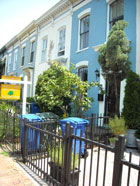
Armed with digital cameras, notebooks, and critical thinking skills, Investigating Where We Live participants observed the D.C. neighborhoods of Brookland, Deanwood, and Stanton Park to gain an understanding of the communities and their residents. They present their findings in an exhibition, on view to the public from July 30, 2008 through January 11, 2009.
Learn more
Major funding for Investigating Where We Live is provided by the Beech Street Foundation and the D.C. Commission on the Arts and Humanities, an agency supported in part by the National Endowment for the Arts, among others.
Building Brain Buster
Q: What famous early American architect's son, who occasionally practiced architecture himself, played a major role in the establishment of the African nation of Liberia?
Think you know the answer? Find out. | |